
 简体中文
简体中文 English
 русский
 বাংলা
বাংলা Việt Nam
 Melayu
 Français
 dansk
dansk slovenščina
 Polski
 suomi
suomi Deutsch
 Lietuvių
 Português
 Nederlands
 日本語
日本語 한국어
한국어 Español
 Türkçe
In modern power systems, the step-up transformer plays an indispensable role. It is the enabling technology that allows electricity generated at medium voltage levels to be transmitted efficiently over hundreds of kilometers. As global energy infrastructure shifts toward renewable integration and ultra-high-voltage (UHV) networks, understanding the principles and evolving applications of step-up transformers is essential for industry stakeholders.
1. Operating Principle
A step-up transformer increases voltage from the primary winding to the secondary winding while decreasing current proportionally, based on Faraday’s law of electromagnetic induction. The turns ratio determines the voltage transformation:
By stepping up voltage (e.g., from 11 kV to 220 kV or higher), the transmission current drops significantly, reducing resistive losses and enabling bulk power transfer over long distances with minimized conductor size requirements.
In practice, these transformers are typically oil-immersed (using mineral oil or natural ester fluids) to provide dielectric insulation and efficient cooling. Core materials often employ grain-oriented silicon steel or amorphous metal to reduce no-load losses—a critical factor given that step-up units in power plants operate continuously.
2. Key Application Scenarios
Conventional Power Generation
In thermal, hydro, and nuclear plants, step-up transformers connect the generator output (typically 10–25 kV) to the transmission grid (110 kV, 220 kV, or higher). These units must withstand high short-circuit stresses and are often custom-engineered for each plant.
Renewable Energy Integration
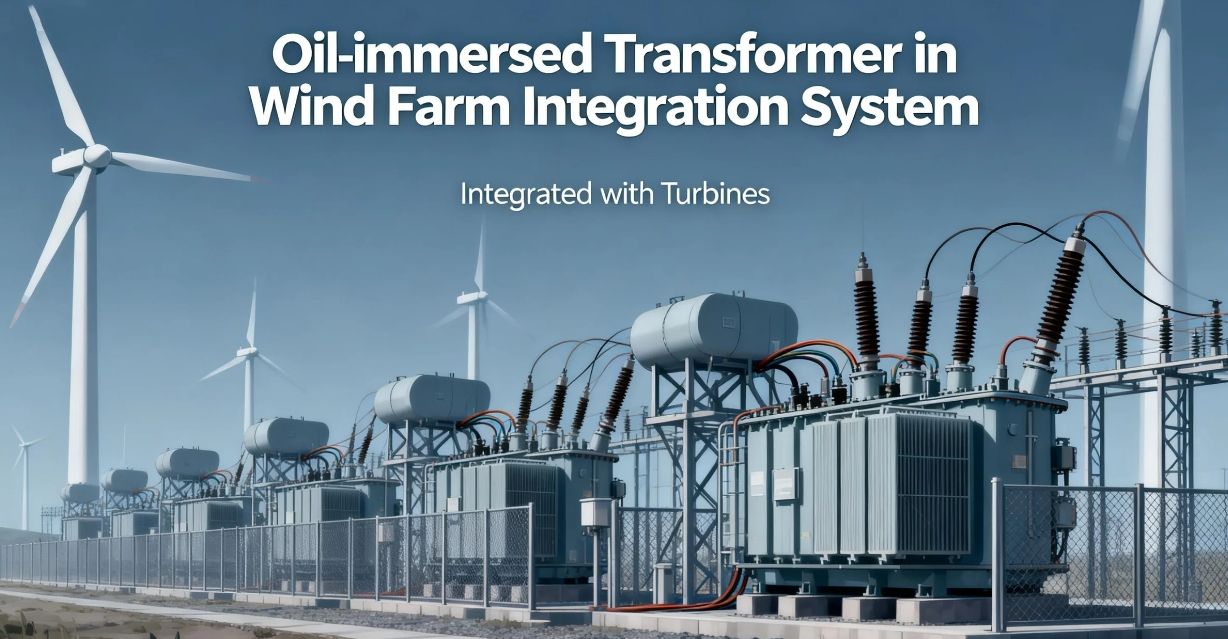
The rapid expansion of solar and wind farms has created surging demand for compact, skid-mounted step-up transformers. In a typical utility-scale solar plant, dozens of inverters feed into a medium-voltage collection system, and a central step-up transformer raises the voltage to transmission levels. For offshore wind, step-up units are installed on turbine platforms or offshore substations, requiring specialized corrosion-resistant enclosures and high reliability under harsh marine conditions.
Ultra-High-Voltage (UHV) Grids
Countries like China, India, and Brazil are deploying UHV DC and AC corridors. Step-up transformers in these projects operate at voltage levels exceeding 1000 kV AC or ±800 kV DC, pushing the limits of insulation design, transport logistics, and on-site assembly.
3. Technological Trends Driving Growth
Shift to Eco-Friendly Insulating Fluids
Environmental regulations are accelerating the adoption of natural ester (vegetable oil) in step-up transformers. Compared to mineral oil, natural esters offer higher fire safety (flash point >300 °C) and biodegradability, making them ideal for wind farms located in ecologically sensitive zones and urban-adjacent solar parks.
Digital Monitoring and Smart Grid Integration
Modern step-up transformers are increasingly equipped with dissolved gas analysis (DGA) sensors, fiber-optic winding temperature monitors, and partial discharge detection. Real-time data feeds into asset management platforms, enabling predictive maintenance—a key selling point for independent power producers (IPPs) seeking to minimize unplanned downtime.
Amorphous Metal Cores
To meet tightening efficiency standards, manufacturers are incorporating amorphous metal cores in distribution-class step-up units (up to 2.5 MVA). These cores reduce no-load losses by 60–70% compared to conventional silicon steel, significantly lowering lifecycle costs for renewable projects where the transformer operates at low load factors during off-peak hours.
4. Market Outlook (2026–2030)
The global step-up transformer market is poised for steady growth, driven by:
Renewable capacity additions: IEA data indicates that annual renewable capacity additions will exceed 500 GW by 2028, each requiring dedicated step-up infrastructure.
Grid modernization and replacement: In North America and Europe, aging transmission assets (average age >40 years) are being replaced with higher-efficiency, digitally enabled units.
Offshore wind expansion: The shift to 15 MW+ turbines and floating wind farms demands larger-capacity step-up transformers (up to 200 MVA per unit) with enhanced mechanical robustness.
Regionally, Asia-Pacific remains the largest market due to rapid industrialization and UHV projects, while North America shows strong growth driven by the Inflation Reduction Act incentives for clean energy infrastructure.
Conclusion
The step-up transformer is no longer a passive component—it is evolving into a smart, eco-efficient asset that directly influences grid reliability and renewable project profitability. For manufacturers and exporters, success lies in delivering customized solutions that combine high efficiency, real-time monitoring, and sustainable fluid options. As the energy transition accelerates, the demand for advanced step-up transformers will continue to rise, making this segment one of the most dynamic in the power equipment industry.