
 简体中文
简体中文 English
 русский
 বাংলা
বাংলা Việt Nam
 Melayu
 Français
 dansk
dansk slovenščina
 Polski
 suomi
suomi Deutsch
 Lietuvių
 Português
 Nederlands
 日本語
日本語 한국어
한국어 Español
 Türkçe
For nearly ten years, three-dimensional wound core transformers (also known as stereo-wound core transformers) remained a niche product—recognized by engineers for their theoretical superiority yet sidelined due to higher manufacturing complexity and upfront costs. Now, tightening grid noise ordinances and aggressive carbon reduction targets are thrusting this technology back into the spotlight.
1. What Makes the 3D Wound Core Different?
Unlike traditional planar stacked cores, the three-dimensional wound core is formed by winding continuous strips of grain-oriented silicon steel into a triangular or hexagonal symmetric structure. This design eliminates air gaps and aligns the magnetic flux path along the grain orientation with virtually no resistance.
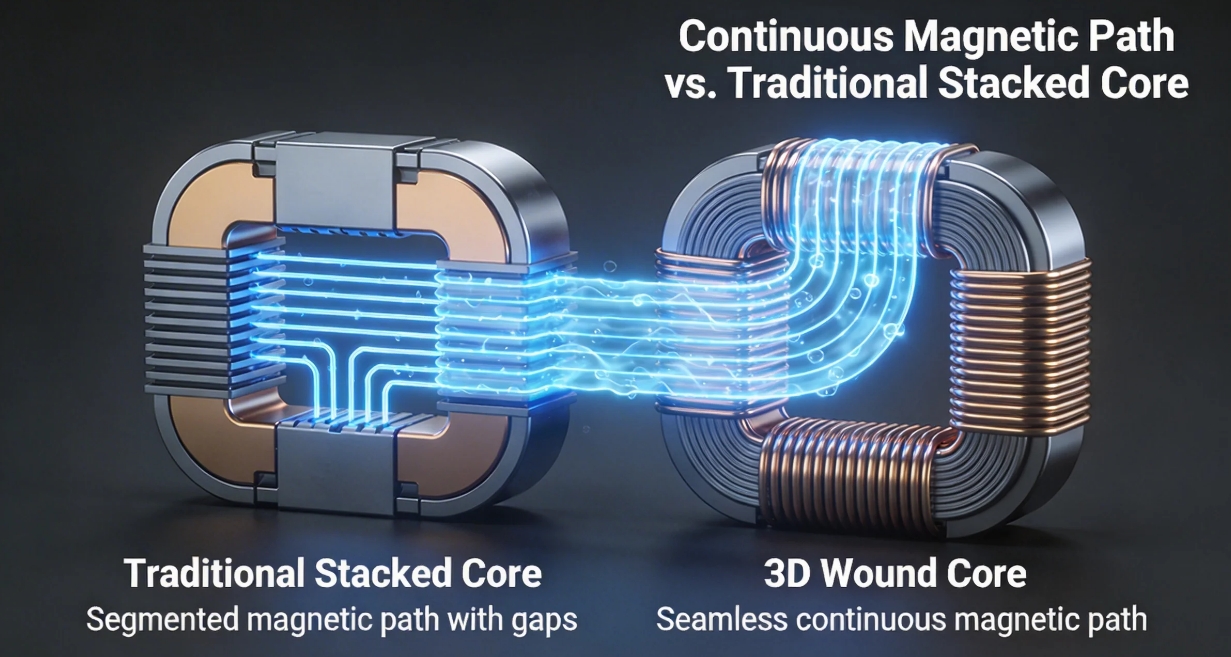
Key technical advantages include:
Ultra-low no-load losses: Up to 30–40% lower than conventional laminated cores of the same rating.
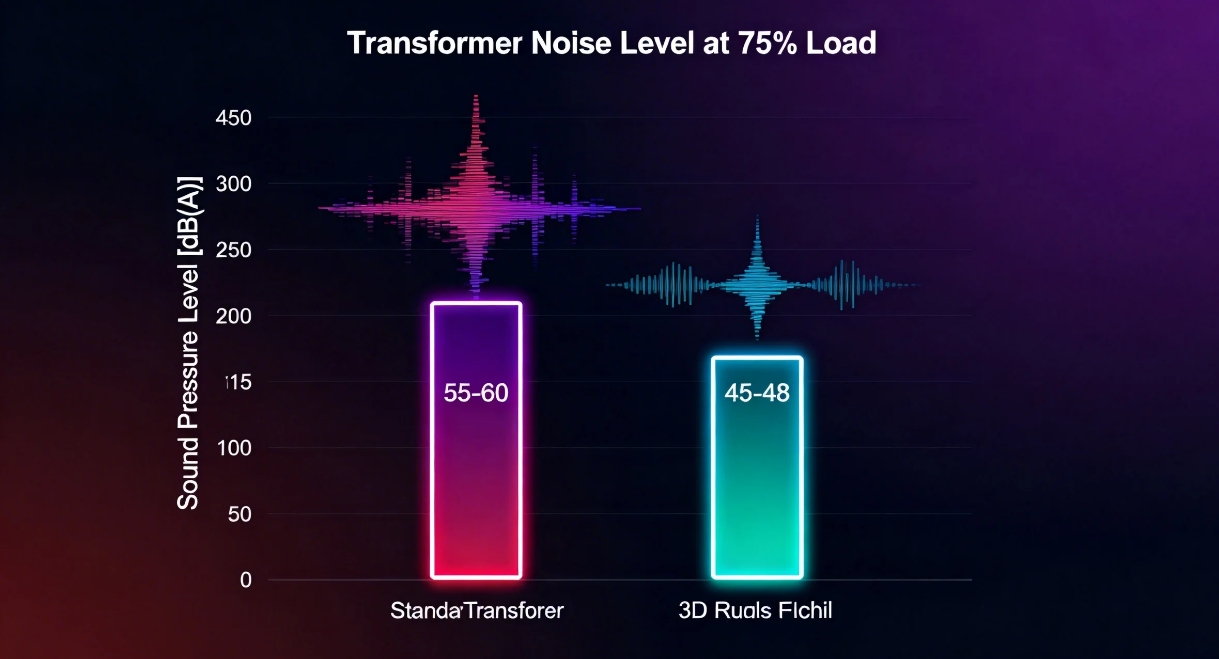
Significantly reduced noise: The symmetric structure minimizes magnetostriction-induced vibration, achieving noise levels 10–15 dB(A) lower than standard oil-immersed transformers—critical for residential and urban substations.
Compact footprint: The three-phase triangular configuration reduces overall volume and weight by approximately 15–20%.
2. Why Did the Market Stay Silent for a Decade?
Despite these benefits, widespread adoption stalled between 2010 and 2020 due to three barriers:
High manufacturing precision: Winding a continuous core in three dimensions requires specialized CNC machinery and skilled labor, increasing initial capital investment.
Repair complexity: Unlike stacked cores, a damaged 3D wound core cannot be easily disassembled, making field repairs challenging.
Conservative utility procurement: Grid operators prioritized proven, low-bid solutions over innovative designs with limited long-term track records.
3. The Drivers Behind the Comeback
Several converging trends are now breaking the decade-long stalemate:
Stricter Noise Regulations
Urban infill substations and residential-area distributed transformers face noise limits as low as 45 dB(A) during nighttime. Traditional transformers often exceed these levels. The 3D wound core’s inherent quiet operation provides a compliance-ready solution without costly external enclosures or active noise cancellation.
Net-Zero Energy Efficiency Mandates
New efficiency standards (e.g., DOE 2027 proposals, EU Ecodesign Lot 5) are pushing no-load loss limits downward. Amorphous metal cores offer even lower losses but suffer from low saturation flux density and mechanical fragility. Three-dimensional wound cores using high-permeability silicon steel strike an optimal balance—near-amorphous losses with robust mechanical integrity.
Rising Energy Prices
For data centers, commercial buildings, and EV charging hubs, every watt of standby loss translates directly to operational expense. The 30–40% reduction in no-load losses offered by 3D wound core transformers delivers a compelling ROI over a 20–30 year service life, especially in high-duty-cycle applications.
Distributed Renewable Integration
Solar canopies, battery storage units, and microgrids require compact, efficient distribution transformers. The 3D wound core’s smaller footprint and lower heat dissipation make it ideal for containerized or skid-mounted power conversion systems.
4. Practical Considerations for Buyers
While the technology is gaining momentum, procurement teams should evaluate:
Manufacturer track record: Request field performance data (noise, loss stability over 5+ years).
Repair and warranty terms: Understand the manufacturer’s protocol for core damage—some offer modular core exchange programs.
Application fit: Best suited for indoor/urban substations, residential complexes, hospitals, and data centers. For remote industrial sites with minimal noise constraints, conventional transformers may remain more cost-effective.
Conclusion
After a decade of quiet development, the three-dimensional wound core transformer is no longer a laboratory curiosity. It has matured into a commercially viable solution that directly addresses two of the industry’s most pressing demands: silent operation and uncompromising efficiency. As utilities and private operators race to decarbonize and densify their grids, this once-overlooked technology is poised for a genuine renaissance.